
2026 Trend Analysis: Why Competitor Analysis Drives Digital Marketing Agency Success
As we navigate 2026, digital marketing agencies face unprecedented transformation. AI integration has accelerated evolution beyond incremental updates—it's reshaping entire strategies, from hyper-personalized content generation to predictive campaign optimization. Traditional approaches relying on historical data and intuition are no longer sufficient; they risk obsolescence in a landscape where competitors leverage real-time AI insights to outmaneuver market shifts.
Competitor analysis has evolved from optional research to a strategic necessity. In 2026, it's not just about tracking rivals' social media or pricing—it's about decoding their AI-driven tactics, identifying emerging technology adoption, and anticipating market disruptions. Agencies that skip this step risk falling behind in an era where competitive intelligence fuels agility.
Practical tip: Start with a weekly competitor audit checklist:
- Monitor AI tool usage in their campaigns
- Analyze content personalization patterns
- Track new service launches or pivots
This proactive approach helps agencies adapt quickly, turning competitive insights into actionable strategies that drive sustainable success.
Key 2026 Trends That Make Competitor Analysis Essential
As we approach 2026, three seismic shifts are making competitor analysis non-negotiable for digital marketing agencies. First, AI-driven search algorithms are moving beyond keyword matching to intent understanding. To stay ahead, analyze competitors' content that ranks for user intent, not just keywords.
Create a checklist:
- Map competitor content to search intent categories
- Identify gaps in their intent coverage
- Develop content that better satisfies user needs
Second, the AI content explosion demands strategic differentiation. With AI tools generating content at scale, your competitive edge comes from insights-driven creativity. Practical tip: Use competitor analysis to identify underserved topics, unique angles, and content formats that resonate with your shared audience. Track which AI-generated content performs well for competitors and adapt your approach accordingly.
Third, hyper-personalization requires competitor-informed targeting. Analyze competitors' audience segmentation, messaging strategies, and personalization tactics. Actionable step: Create a competitor personalization audit—document their email sequences, retargeting strategies, and dynamic content approaches. Use these insights to develop more sophisticated, data-informed personalization that outperforms theirs.
In 2026, competitor analysis transforms from optional research to essential intelligence that powers AI-optimized content, differentiated positioning, and superior personalization.
Strategic Advantages of Competitor Analysis for Digital Marketing Agencies
Competitor analysis provides digital marketing agencies with three strategic advantages in 2026. First, systematic monitoring reveals market gaps before competitors notice them. Track competitors' content gaps, underserved geographic areas, or emerging service needs through social listening and content audits. Create a quarterly 'opportunity matrix' comparing your capabilities against competitor weaknesses.
Second, benchmark performance metrics to set realistic client expectations. Analyze competitors' average campaign results, client retention rates, and service delivery timelines. Use this data to establish industry-standard KPIs and transparently communicate what's achievable. Implement a dashboard tracking 5-7 key competitor metrics monthly.
Third, inform pricing strategies based on competitive positioning. Map competitors' service packages against pricing tiers to identify premium opportunities or value gaps. Consider offering tiered packages that undercut competitors on basic services while adding unique high-value components. Regularly review competitor pricing changes and adjust your positioning accordingly.
Practical steps:
- Conduct quarterly competitor audits focusing on service gaps
- Maintain a competitor performance benchmark database
- Test pricing strategies against 2-3 closest competitors quarterly
- Use competitive intelligence to justify premium pricing for differentiated services
Practical Implementation: How to Conduct Effective Competitor Analysis in 2026
In 2026, effective competitor analysis for digital marketing agencies requires a blend of AI-powered automation and strategic human insight. Start by implementing AI tools like RivalSense for real-time tracking of competitor activities across channels—these platforms automatically collect data on content, ads, and engagement, freeing your team for deeper analysis.
Next, analyze competitor content strategies on emerging platforms such as immersive AR/VR spaces and AI-generated video. Map their content mix, posting frequency, and audience interactions to identify gaps and opportunities. Use this data to benchmark your own performance and test new formats.
For ad creative, monitor competitor messaging, visuals, and CTAs using AI-driven dashboards. Track A/B test variations and performance metrics to uncover winning approaches. Create a checklist:
- Weekly reviews of top-performing ads
- Monthly deep-dives into creative trends
- Quarterly strategy adjustments based on insights
Tip: Combine quantitative data with qualitative analysis—AI flags trends, but human interpretation reveals the 'why' behind successes. Prioritize actionable insights over raw data to drive agile campaign optimizations.
Real-World Competitor Insights: Why They Matter for Strategy
Tracking specific competitor moves can provide invaluable insights for shaping your business strategy. By monitoring personnel changes, legal updates, and partnership announcements, you can anticipate market shifts and identify opportunities. Here are real examples from RivalSense that demonstrate the strategic value of such intelligence.
Example 1: Leadership Changes Signal Strategic Shifts
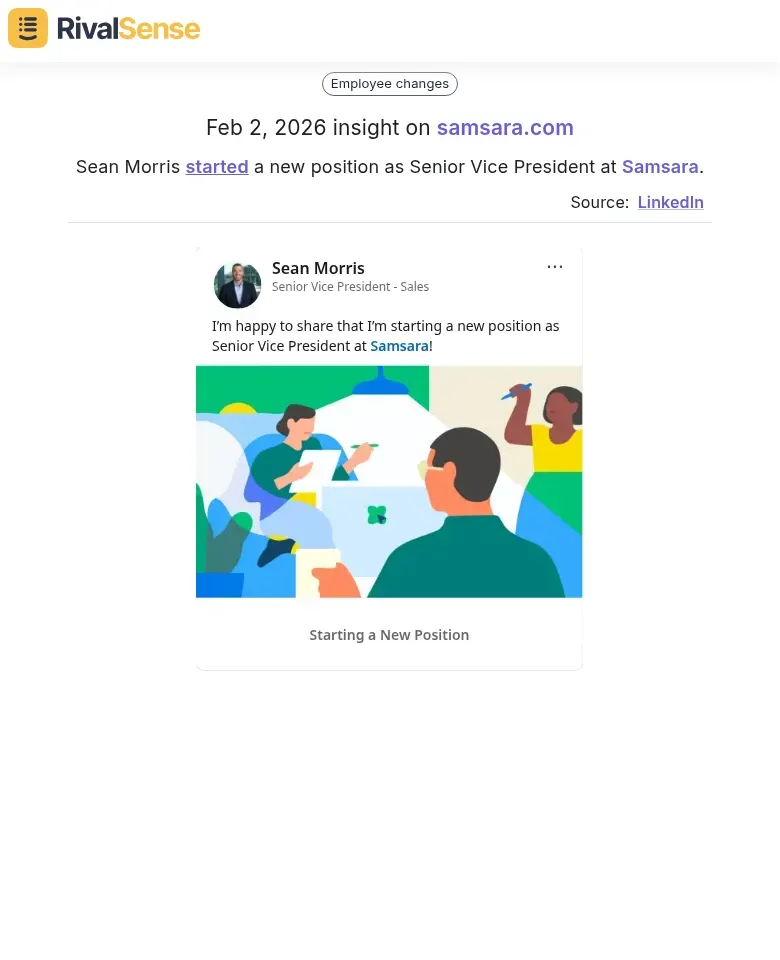
When a key competitor hires a senior executive like Sean Morris as Senior Vice President, it often indicates a new strategic direction or focus area. For digital marketing agencies, this could mean Samsara is doubling down on certain markets or technologies, allowing you to adjust your offerings or prepare for increased competition.
Example 2: Legal Updates Impact Compliance and Risk
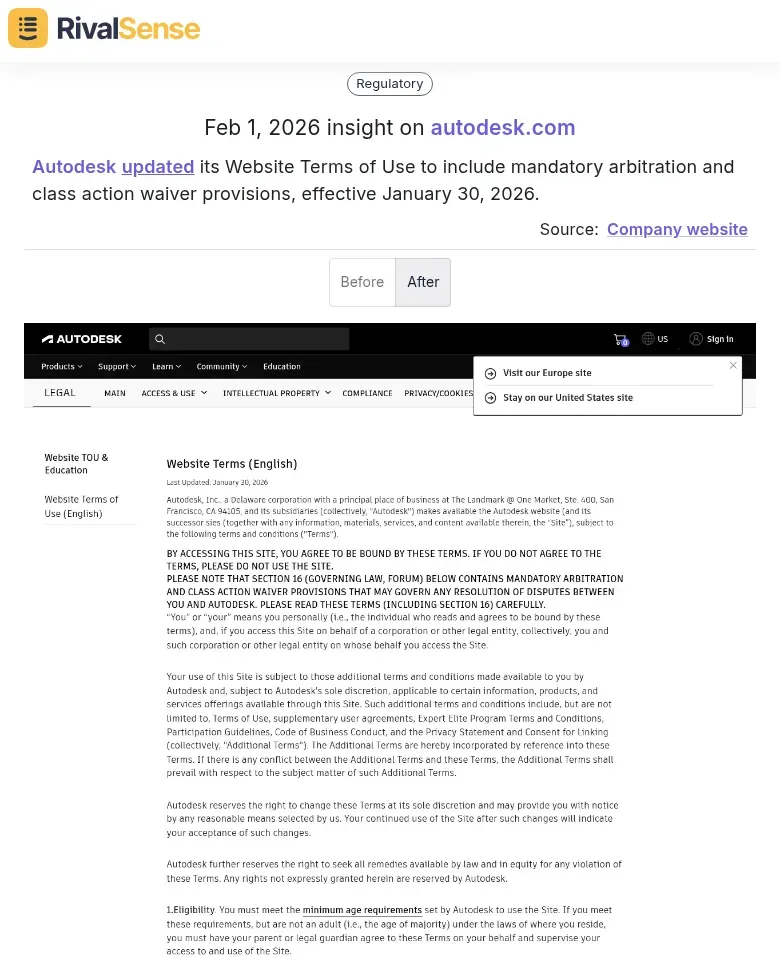
Autodesk's update to include mandatory arbitration and class action waiver provisions, effective January 30, 2026, highlights how legal changes can affect business operations. For agencies, similar updates from competitors might signal industry-wide regulatory trends, helping you stay compliant and advise clients proactively.
Example 3: New Hires Reveal Expansion Plans
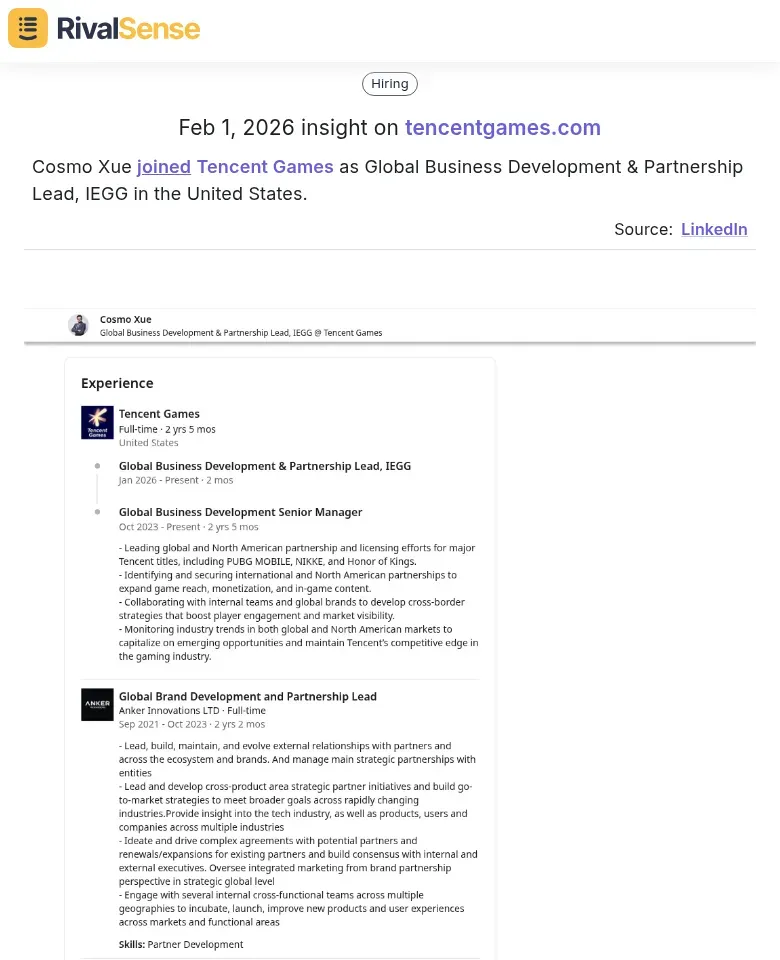
Cosmo Xue's role at Tencent Games in the United States suggests a push for global partnerships and business development. For agencies, tracking such hires can reveal competitors' expansion into new regions or sectors, enabling you to explore similar opportunities or strengthen your positioning.
By leveraging tools like RivalSense, you can automatically track these insights and turn them into actionable strategies.
Case Studies: Agencies Winning Through Competitor Intelligence
Forward-thinking agencies are leveraging competitor intelligence to secure new business and strengthen client relationships. Agency X, a North American mid-sized firm, transformed its approach by analyzing competitor pricing models and service gaps. They discovered competitors were charging premium rates for AI-driven analytics but delivering minimal client ROI. Agency X developed a proprietary dashboard integrating competitor insights with client data, offering transparent performance tracking. This pivot resulted in a 34% increase in client renewals and 18% profit margin growth.
EuroBrand Studio identified competitors were struggling with GDPR compliance in European markets. By analyzing their gaps, they created a cookieless campaign framework that increased client engagement by 42% while maintaining privacy compliance. APAC Live Labs studied competitor live commerce failures in Asia-Pacific, then developed specialized influencer-commerce integration that generated $10M in incremental sales for a cosmetics brand.
Practical Checklist for Agencies:
- Weekly competitor content gap analysis
- Monthly pricing and service model benchmarking
- Quarterly competitor technology stack audits
- Client-facing competitor intelligence reports
- Competitor case study reverse-engineering sessions
Key metrics to track: Client acquisition cost reduction, client retention rate improvement, average contract value increase, and campaign ROI uplift through competitor-informed optimizations.
Future-Proofing Your Agency: Building a Competitor-Centric Culture
Future-proofing requires embedding competitor analysis into your agency's DNA. Start by integrating competitive insights into weekly client reporting dashboards—not as an afterthought, but as a core metric alongside performance data. Create standardized competitor tracking templates that teams use during client onboarding and quarterly reviews.
Train your teams to think competitively through monthly 'opportunity spotting' workshops where account managers analyze competitor weaknesses and identify service gaps. Implement a simple 3-step framework:
- Monitor 3-5 key competitors per client
- Track their content, pricing, and service changes weekly
- Document actionable opportunities in a shared competitive intelligence hub
Develop proprietary systems by combining automated tracking tools with human analysis. Create custom dashboards that alert teams to competitor website changes, new service launches, or pricing adjustments. Establish a 'competitive intelligence champion' role on each account team responsible for maintaining and updating competitor profiles.
Practical checklist:
- Dedicate 30 minutes weekly to competitor review per client
- Include competitor analysis in all client strategy meetings
- Create a 'competitor opportunity' column in your project management system
- Train new hires on your competitive analysis framework during onboarding
- Quarterly competitive landscape reports for all retained clients
This culture shift transforms reactive monitoring into proactive opportunity identification, giving your agency sustained competitive advantage in 2026's dynamic market.
Conclusion: Taking Action with Competitor Intelligence
To stay ahead in 2026, competitor analysis is no longer optional—it's essential. By implementing the strategies outlined above, you can turn competitive intelligence into a powerful driver of growth and innovation for your digital marketing agency.
Ready to streamline your competitor tracking? Try out RivalSense for free at https://rivalsense.co/ to automate insights on product launches, pricing updates, management changes, and more. Get your first competitor report today and start making data-driven decisions that propel your agency forward.
📚 Read more
👉 How Adidas' CLOT Partnership Served as a Competitive Intelligence Wake-Up Call
👉 Step-by-Step Guide to Facebook Competitor Insights for Key Account Management
👉 Web Scraping for Customer Service Excellence: Benchmarks, Benefits, and Implementation
👉 Real-World Competitor Insights: Hiring and Layoff Patterns for Key Account Strategy
👉 Decoding Competitor Moves: A Real-World Analysis of Paige Powers' Transition to Fortinet