
2026 Trend Analysis: Tracking Competitor Glassdoor Reviews for Branding Consultancies
In 2026's hyper-competitive branding consultancy landscape, employer branding has become a decisive battleground in the talent war. Top-tier consultants gravitate toward firms with strong workplace cultures, making Glassdoor reviews an invaluable source of unfiltered competitive intelligence. These candid employee insights reveal competitor strengths, weaknesses, and cultural nuances that traditional market research often misses.
Glassdoor provides real-time sentiment analysis on workplace culture, leadership effectiveness, and employee satisfaction—critical factors for branding firms whose success hinges on talent retention and innovation. By tracking competitor reviews, consultancies can identify emerging talent concerns, benchmark their own employee experience, and uncover strategic vulnerabilities in rival firms.
Practical steps for 2026:
- ✅ Monitor key competitors' Glassdoor ratings weekly
- ✅ Analyze recurring themes in employee feedback
- ✅ Track sentiment trends around leadership changes or major announcements
- ✅ Benchmark your firm's ratings against industry averages
- ✅ Use insights to refine recruitment messaging and retention strategies
This intelligence enables proactive talent strategy adjustments and helps position your firm as an employer of choice in the crowded consultancy market.
Key 2026 Trends in Glassdoor Reviews for Branding Consultancies
In 2026, branding consultancies face three critical Glassdoor trends that directly impact employer branding. First, the employee-leader disconnect is widening, with creative professionals increasingly rating leadership poorly despite positive company ratings. This signals misalignment between management perception and ground-level experience, particularly in client-facing roles.
Second, 'forever layoffs'—ongoing, small-scale workforce reductions—create pervasive job insecurity. Unlike traditional layoffs, these continuous cuts erode trust and stability, leading to declining 'job security' ratings even in profitable firms.
Third, remote/hybrid work tensions are reshaping career opportunity perceptions. Creative consultancies struggle with equitable advancement for remote staff, causing disparities in 'career growth' ratings between office-based and remote employees.
Practical steps:
- 🔍 Conduct quarterly sentiment analysis comparing leadership vs. overall company ratings
- 🔍 Implement transparent communication protocols during workforce changes
- 🔍 Create hybrid-specific career development tracks with measurable milestones
- 🔍 Benchmark against industry-specific Glassdoor metrics monthly
- 🔍 Address negative trends within 30 days through targeted action plans
Monitor these metrics:
- Leadership approval ratings
- Job security scores
- Career opportunity ratings by work arrangement
- Review sentiment around organizational changes
Competitor Analysis Framework: What to Track in Rival Consultancies' Reviews
To effectively track competitor Glassdoor reviews, implement this structured framework. First, monitor leadership ratings quarterly, focusing on CEO approval and management trust scores. Create a dashboard tracking these metrics across 3-5 key competitors, noting correlations with employee retention rates.
Second, analyze compensation trends systematically. Track salary satisfaction scores, bonus frequency mentions, and benefits comparisons (healthcare, remote work policies, professional development budgets). Use sentiment analysis to identify which benefits drive highest satisfaction in the branding consultancy space.
Third, measure project satisfaction through review keywords: 'creative fulfillment,' 'client variety,' and 'portfolio growth.' Track work-life balance mentions against project timelines. Create a quarterly report comparing these metrics across competitors, identifying patterns where high creative fulfillment correlates with specific project types or team structures.
Practical checklist:
- [ ] Set up automated alerts for new reviews of top 5 competitors
- [ ] Create standardized scoring system (1-5 scale) for each metric category
- [ ] Hold quarterly competitive analysis meetings to review trends
- [ ] Track review volume changes after competitor PR announcements
- [ ] Correlate Glassdoor metrics with competitor client wins and talent movements
Actionable Intelligence: Turning Competitor Review Data into Strategic Advantage
Glassdoor reviews offer more than employee sentiment—they're a strategic intelligence goldmine for branding consultancies. Here's how to transform competitor review data into actionable insights:
🎯 Identify Competitor Weaknesses for Recruitment & Client Pitches
- Scan reviews for recurring complaints about leadership, work-life balance, or project management
- Use phrases like "management doesn't listen" or "constant overtime" as talking points in client pitches
- Example: If Competitor X has 40+ reviews mentioning "poor communication," position your consultancy's transparent processes as a key differentiator
📊 Benchmark Your Strengths Against Industry Standards
- Calculate average ratings for key categories (culture, compensation, leadership) across top 5 competitors
- Create a scorecard comparing your consultancy's Glassdoor metrics against industry averages and top performers
- Tip: Track quarterly trends—if competitor ratings drop in "career growth," highlight your mentorship programs
🔮 Anticipate Talent Retention & Market Shifts
- Monitor review volume spikes (sudden increases often precede talent exodus)
- Analyze sentiment trends around specific services or client types mentioned
- Checklist: Track mentions of "burnout," "layoffs," or "restructuring" to predict competitor instability
Practical Implementation Steps:
- ⚙️ Set up automated alerts for competitor Glassdoor page changes
- ⚙️ Create a monthly review analysis dashboard with key metrics
- ⚙️ Share insights with recruitment and business development teams weekly
- ⚙️ Update competitive positioning based on quarterly review pattern analysis
By systematically analyzing competitor Glassdoor data, you gain predictive intelligence about talent movements, service weaknesses, and market opportunities—turning employee feedback into competitive advantage.
Expanding Your Competitive Intelligence: Beyond Glassdoor Reviews
While Glassdoor reviews provide invaluable insights into competitor culture and talent sentiment, a comprehensive competitive intelligence strategy should encompass multiple data sources. Tracking broader competitor activities can reveal strategic shifts, market positioning, and operational changes that impact your business. Integrating these signals with Glassdoor data creates a holistic view, enabling more informed decision-making for founders and CEOs.
Consider these real-world examples from RivalSense, a competitor tracking tool, to illustrate the value of diverse insights:
💰 Financial Milestones
Harvey's CEO Winston Weinberg announced that the company reached over $190 million in annual recurring revenue and served more than 1,000 customers across 59 countries in 2025.
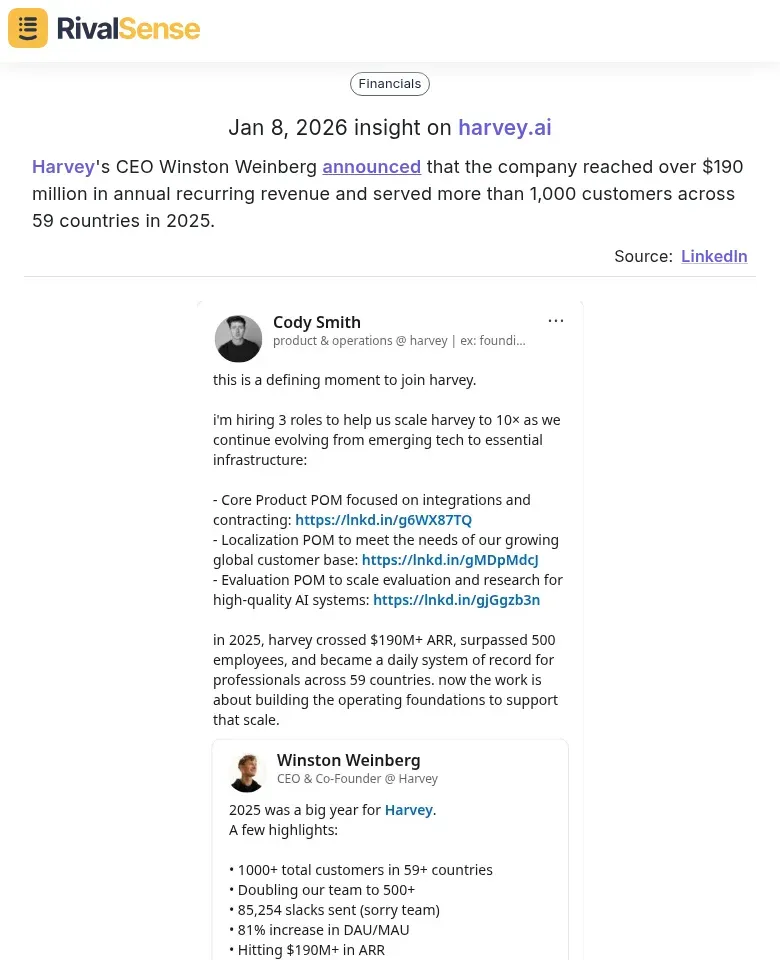
Why it matters: Tracking financial achievements helps you gauge competitor growth, market expansion, and resource allocation. This insight can inform your own pricing strategies, target markets, and investment priorities, giving you a edge in strategic planning.
🎪 Event Participations
Fanatics announced athletes for Fanatics Fest through a Royal Rumble hosted by Cam Skattebo.
Why it matters: Monitoring event announcements reveals competitor marketing strategies, audience engagement tactics, and partnership networks. Use this to benchmark your own events, identify potential collaboration opportunities, and adapt your branding efforts to stay competitive.
👔 Management Changes
Colby Garland left Hootsuite as Team Lead II, Software Development in Canada to become Chief Technology Officer at Insurely Inc.
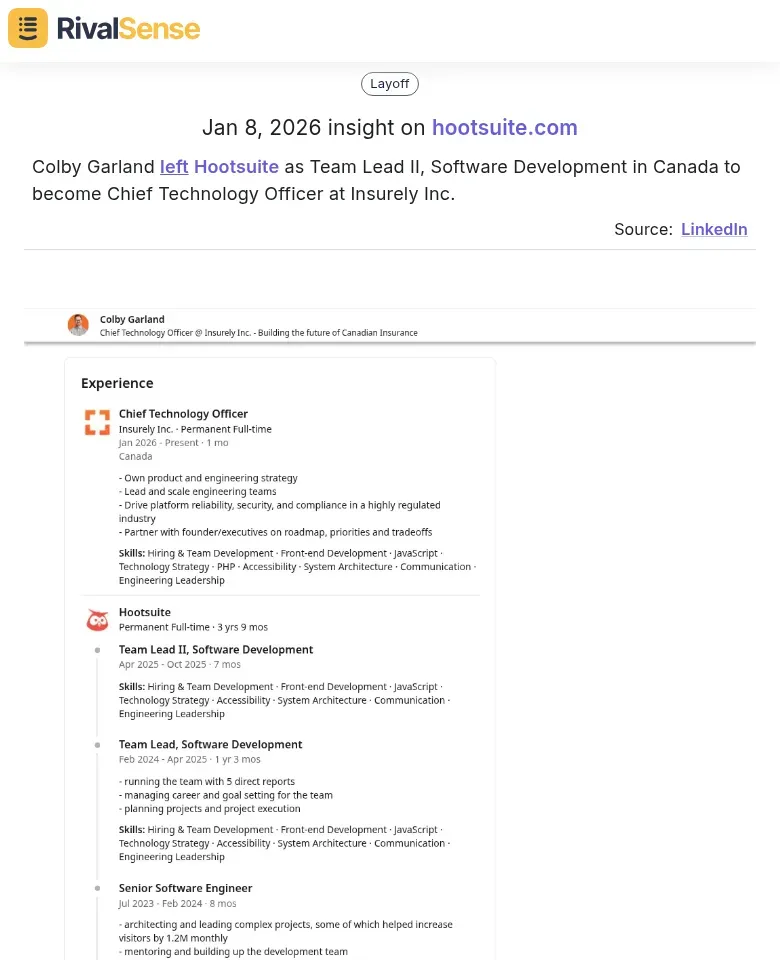
Why it matters: Leadership movements signal strategic direction changes, talent acquisition trends, and potential instability. This intelligence can help you anticipate competitor pivots, strengthen your own recruitment efforts, and assess competitive threats in the talent market.
Implementation Guide: Setting Up Your Competitor Glassdoor Tracking System
To implement a systematic competitor Glassdoor tracking system, start by selecting the right tools. Use specialized competitor intelligence platforms that automate review collection and analysis, or set up custom monitoring with web scraping tools and alerts for specific competitor names. Create a centralized dashboard to track key metrics across all target consultancies, ensuring data is actionable and timely.
Establish clear KPIs: monitor overall ratings (1-5 stars), review volume trends, sentiment analysis of key themes (work culture, leadership, compensation), and specific mentions of your brand in competitor reviews. Set up automated alerts for significant changes—when a competitor's rating drops by 0.5+ points, when negative review volume spikes by 30%+ in a week, or when your brand appears in competitor reviews.
Integrate Glassdoor intelligence into your competitive analysis by creating a quarterly competitor review report. Include:
- 📋 Executive summary of key findings
- 📋 Comparative rating analysis
- 📋 Emerging themes and sentiment shifts
- 📋 Actionable insights for your branding strategy
Use this data to identify competitor weaknesses you can exploit, understand market perception gaps, and benchmark your own employer brand against industry standards.
Practical tip: Create a simple checklist—weekly review monitoring, monthly trend analysis, quarterly competitive positioning assessment. Remember to track both quantitative metrics and qualitative insights for a complete picture.
Conclusion: The Future of Competitive Intelligence in Branding Consultancies
As we look toward 2026 and beyond, competitor Glassdoor review tracking will evolve from manual monitoring to AI-powered intelligence systems. Advanced analytics will automatically detect sentiment shifts, identify emerging talent concerns, and predict competitor vulnerabilities before they become public crises. For branding consultancies, staying ahead means embracing these technologies while maintaining a human-centric approach to data interpretation.
To build a culture of continuous competitive intelligence:
- 🏢 Assign dedicated team members to monitor key competitor reviews weekly
- 🏢 Create automated alerts for negative sentiment spikes or leadership changes
- 🏢 Conduct quarterly competitive intelligence workshops to share insights across departments
- 🏢 Integrate Glassdoor data with other competitive signals (pricing, service offerings, client wins)
Practical steps to turn insights into sustainable advantage:
- 🔄 Benchmark your own Glassdoor metrics against top competitors monthly
- 🔄 Identify patterns in competitor weaknesses and develop corresponding strengths in your consultancy
- 🔄 Use negative competitor reviews as opportunities to highlight your firm's strengths in proposals
- 🔄 Create a feedback loop where Glassdoor insights inform your talent retention strategies
By 2026, the most successful branding consultancies won't just track competitors—they'll predict their moves, anticipate their talent challenges, and position themselves strategically in response. The future belongs to consultancies that transform Glassdoor data from reactive monitoring into proactive strategic advantage.
Ready to elevate your competitive intelligence? Try RivalSense for free to track competitor product launches, pricing updates, event participations, partnerships, regulatory aspects, management changes, and media mentions—all delivered in a weekly email report. Get your first competitor report today and stay ahead in the branding consultancy market!
📚 Read more
👉 How Hubstaff's SCIM Move Forced Competitors to Accelerate Enterprise Security
👉 Advanced Competitor Intelligence: Uncover Why Customers Choose Competitors
👉 Workflow Automation CRM Benchmarking: Key Account Tracking Insights
👉 Regulatory Competitor Insights: 5 Common Mistakes Key Account Managers Must Avoid
👉 Mastering Competitor Analysis: Insights from Hiring Trends