
2026 Sports Retail Trends: Automating Key Account Intelligence for Competitive Edge
The 2026 sports retail landscape is defined by unprecedented velocity. 🚀 Consumer preferences shift overnight, new competitors emerge weekly, and pricing strategies evolve in real-time. In this environment, traditional manual tracking methods—spreadsheets, periodic market reports, and manual website checks—are dangerously obsolete. They create intelligence gaps that leave businesses vulnerable to sudden market shifts and competitor maneuvers.
Forward-thinking sports retailers now recognize that automated key account intelligence is no longer optional—it's the foundation of market leadership. By implementing systems that continuously monitor competitor pricing, product assortments, promotional strategies, and inventory changes across key accounts, businesses gain the real-time visibility needed to make proactive decisions.
Practical Implementation Steps:
- ✅ Identify your 5-10 most critical competitor accounts to monitor
- ✅ Define key metrics: pricing changes, new product launches, stock availability
- ✅ Automate data collection through specialized tracking tools
- ✅ Set up real-time alerts for significant competitive moves
- ✅ Integrate intelligence into weekly strategic planning sessions
This automated approach transforms reactive guesswork into proactive strategy, enabling sports retailers to anticipate market trends rather than merely respond to them.
Learning from Competitor Expansion Patterns: Geographic and Format Intelligence
Analyzing competitor expansion patterns reveals critical market intelligence. Start by mapping their geographic footprint over time—are they clustering in urban centers or expanding to suburban markets? For instance, if a rival opens three stores in Austin within 18 months, it signals strong local demand you might have overlooked.
Store format evolution offers strategic insights. Track the ratio of outlet to flagship stores—a shift toward outlets may indicate margin pressure or inventory management challenges. When competitors launch experiential flagship stores with AR fitting rooms, they're likely targeting premium segments you could be missing.
Real-World Example: Tools like RivalSense provide automated insights into such expansions. For example, Stadium opened new stores in Sweden and Finland in 2025, including Stadium Outlet Bro and stores in Kajaani and Riihimäki, and celebrated 10 years of Stadium Outlet in Finland. 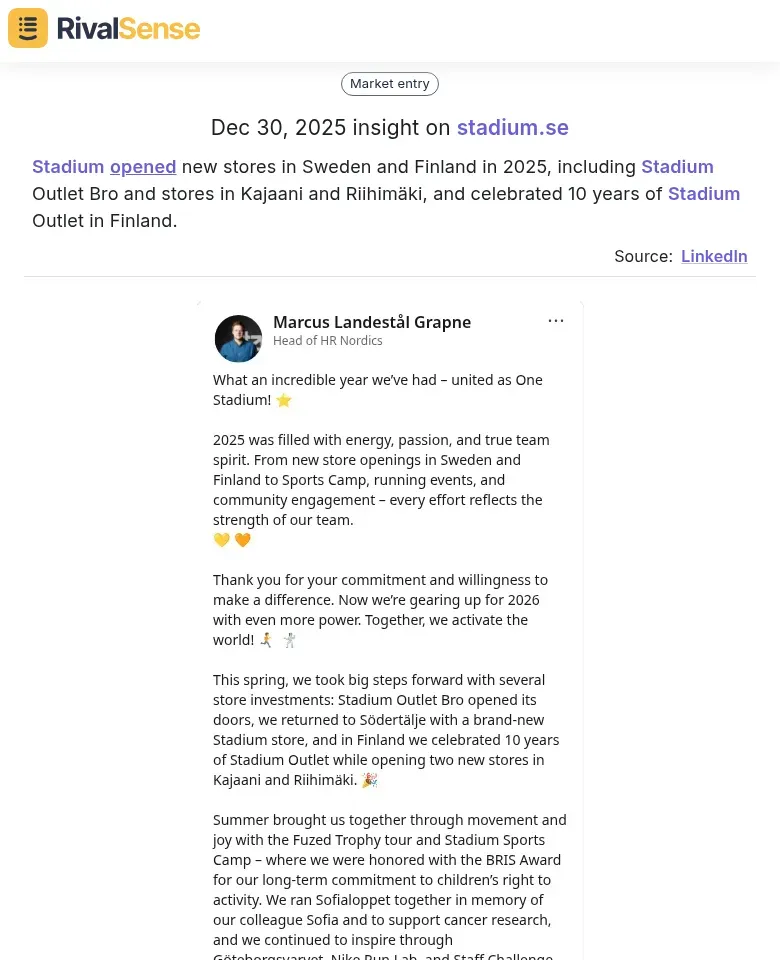 Tracking these moves helps understand geographic strategies and identify untapped markets, which is invaluable for planning your own expansion.
Practical Steps:
- 📍 Create a timeline of competitor store openings by region
- 🏬 Categorize each location by format (flagship, outlet, pop-up)
- 🎯 Note anniversary milestones - 5+ year stores indicate successful market penetration
- 🔄 Monitor format changes (conversions from outlet to flagship signal market strength)
Key Insight: Competitors expanding into secondary cities before major metros may be testing lower-risk markets first. Their format mix reveals target demographics—heavy outlet presence suggests value-focused strategy, while flagship concentration indicates premium positioning. Track these patterns quarterly to anticipate their next moves and identify underserved markets for your own expansion.
Strategic Partnership Intelligence: Decoding Long-Term Alliance Strategies
Strategic partnerships reveal more than just marketing announcements—they signal long-term market positioning. To decode these alliances, start by tracking partnership extensions beyond initial terms. When Nike extends its 10-year deal with the NBA through 2036, that's not just renewal—it's a $1.5B commitment signaling deep market penetration goals.
Analyze deal magnitude and duration systematically. Create a spreadsheet tracking: (1) Partnership value (2) Contract length (3) Exclusivity clauses (4) Performance incentives. Compare Adidas's 5-year, $500M MLB deal against Under Armour's 10-year, $1B NFL commitment—the latter shows stronger competitive positioning through longer-term investment.
Real-World Example: Automated monitoring can capture partnership extensions efficiently. For instance, Stadium extended its partnership with BP and Nike until 2030 in the largest deal in the club's history. 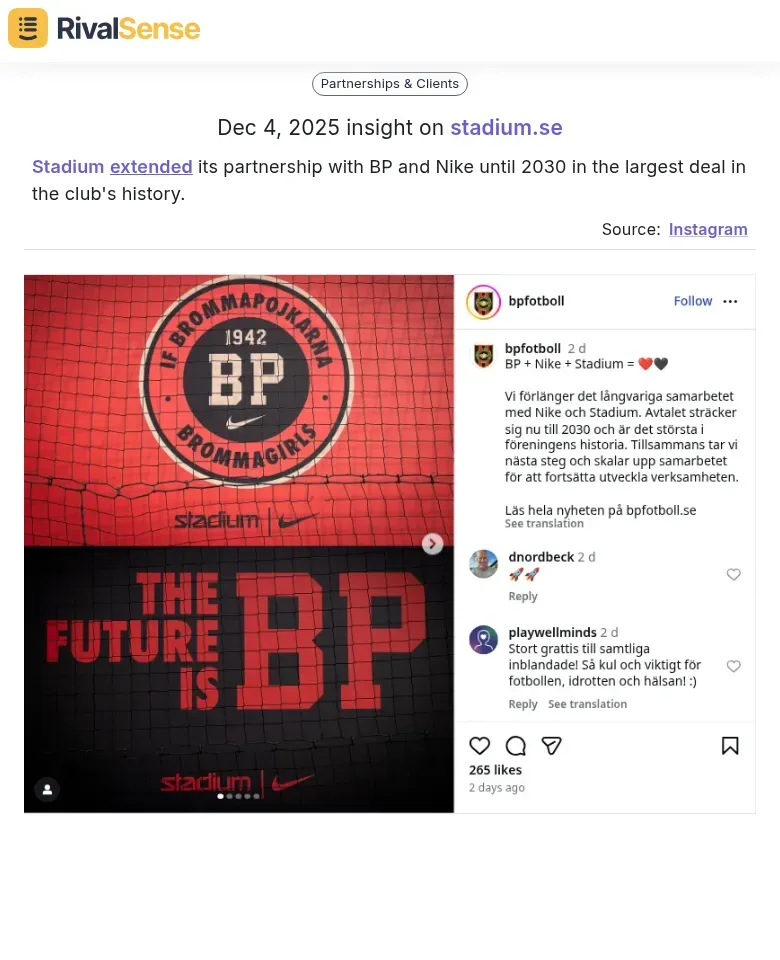 This type of insight is crucial for understanding competitor commitments and refining your own partnership strategies.
Practical Checklist:
- 📊 Monitor SEC filings for partnership financial disclosures
- 🗣️ Track executive statements about "long-term vision" and "strategic alignment"
- 🔄 Compare partnership portfolios across competitors quarterly
- 📅 Note which sports/leagues get multi-year vs. annual renewals
- 🔒 Analyze exclusivity windows for market access advantages
Key Insight: The most revealing intelligence comes from what happens after the initial announcement—renewals, expansions, and early terminations tell the real story of strategic commitment.
Location Intelligence: The Strategic Value of Store Placement and Timing
Location intelligence transforms store placement from guesswork to strategic advantage. By analyzing competitor store openings, you can decode market segmentation strategies—like why a premium brand targets affluent suburbs while a value retailer expands in urban transit hubs. Timing intelligence reveals seasonal patterns: holiday-focused openings in Q4, back-to-school expansions in summer, or strategic moves before major sporting events.
Suburban vs. urban patterns expose target demographics: suburban growth signals family-focused offerings with parking and space, while urban expansion targets younger, mobile professionals with convenience-first formats.
Real-World Example: Keeping tabs on new openings is key. For example, Stadium opened a new outlet store in Värmdö outside Stockholm on November 6. 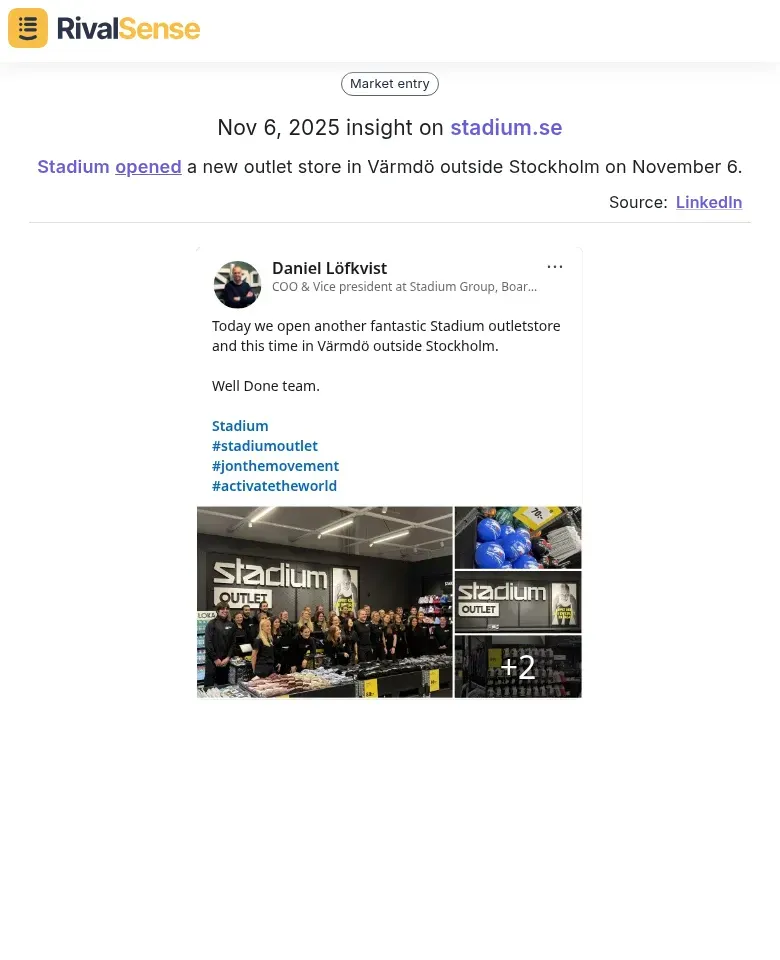 This insight helps analyze location choices and timing, aiding in demographic analysis and competitive response.
Practical Steps:
- 🗺️ Map competitor store locations against demographic data (income, age, density)
- 📅 Track opening dates to identify seasonal timing patterns
- 🚆 Analyze proximity to transportation, competitors, and complementary businesses
- 🏙️ Monitor suburban vs. urban ratios to predict demographic shifts
- 🔔 Use automated tools to alert on new openings and closures
Tip: Combine location data with social media sentiment analysis from surrounding areas to validate demographic assumptions. Timing alerts before peak seasons give you 2-3 months to adjust inventory and marketing.
Automating Key Account Intelligence: The 2026 Technology Stack
In 2026, sports retailers are leveraging a sophisticated technology stack to automate key account intelligence. Real-time monitoring systems track competitor store openings and expansions using geospatial analytics and satellite imagery, alerting you to new market entries within hours. Automated partnership tracking tools scrape social media, press releases, and regulatory filings to identify competitor deals with athletes, teams, and brands, analyzing contract terms and exclusivity clauses.
Predictive analytics now forecast competitor moves by analyzing 5+ years of expansion data, identifying seasonal patterns and market saturation thresholds. The 2026 stack includes machine learning models that predict which cities competitors will target next based on demographic trends and existing store density. Retail leaders are creating competitive dashboards that update automatically, replacing manual spreadsheet tracking with real-time intelligence feeds.
Practical Steps:
- 🛰️ Implement geofencing alerts for competitor locations
- 🤖 Set up automated web scraping for partnership announcements
- 📊 Use AI to analyze historical expansion patterns
Key Checklist:
- ✅ Integrate satellite imagery with local permit databases
- ✅ Automate social listening for partnership clues
- ✅ Build predictive models using historical expansion data
- ✅ Set up alert thresholds for market share changes
This automated approach provides 24/7 competitive monitoring, freeing teams to focus on strategic response rather than data collection.
Actionable Intelligence: Turning Competitor Insights into Competitive Advantage
In 2026, sports retailers can transform competitor insights into tangible competitive advantages through three strategic applications. First, develop counter-strategies by analyzing competitor expansion patterns. When a rival opens stores in new regions, map their geographic footprint and identify underserved markets they've overlooked. For example, if a competitor focuses on urban centers, consider suburban or rural locations with less competition.
Second, optimize partnership negotiations using competitor deal intelligence. Monitor which brands your competitors partner with and the terms they secure. Before negotiating with a supplier, research what deals your rivals have—this intelligence strengthens your bargaining position.
Third, create proactive market entry strategies informed by competitor timing and location data. If competitors consistently launch products in Q3, consider preemptive Q2 releases to capture early adopters. Analyze their location choices to avoid oversaturated markets and target emerging hotspots.
Practical Step: Build a timeline of competitor product launches and store openings over the past two years to predict future moves and time your entries strategically.
Checklist for Actionable Intelligence:
- 🗺️ Map competitor expansion to find gaps
- 🤝 Use partnership data for negotiation leverage
- 📅 Time your launches based on competitor patterns
- 🔍 Continuously monitor for new insights
Put Intelligence into Action with RivalSense
To stay ahead in the fast-paced sports retail market, automated competitor intelligence is essential. Tools like RivalSense track competitor product launches, pricing updates, event participations, partnerships, regulatory aspects, management changes, and media mentions across company websites, social media, and various registries. All this information is delivered in a weekly email report, saving you time and ensuring you never miss a critical move.
Ready to transform your competitive strategy? Try out RivalSense for free at https://rivalsense.co/ and get your first competitor report today! 🚀
📚 Read more
👉 Regulatory Intelligence Workflow: Uncover Competitor Technology Stack Advantages
👉 Competitor Analysis in Action: Decoding WeightWatchers' Strategic Event
👉 The Strategic Benefits of Tracking Industry Leaders: Your 2026 Guide to Competitive Advantage
👉 2026 Warehousing Financial Trends: Competitor Analysis for Distribution Leaders