
2026 Brand Sentiment Analysis for Management Consulting Competitors
In 2026, management consulting firms face a transformed competitive landscape where brand sentiment analysis has evolved from traditional reputation monitoring to AI-driven, real-time intelligence. The shift is driven by advanced algorithms that parse client reviews, social media chatter, and industry discourse to uncover nuanced perceptions—moving beyond mere brand awareness to predictive insights on client trust and satisfaction. Market dynamics, including economic volatility and digital transformation pressures, are reshaping how clients view consulting partners. Firms are now judged not just on expertise but on agility, ethical AI use, and post-engagement value. Real-time sentiment tracking has become critical for strategic positioning, allowing firms to pivot messaging, address emerging concerns, and capitalize on competitor vulnerabilities instantly.
Practical steps for firms:
- Implement AI tools that aggregate sentiment data from diverse sources (e.g., LinkedIn, review platforms).
- Set up alerts for sentiment shifts related to key competitors or industry trends.
- Analyze sentiment drivers—identify whether negative perceptions stem from service delivery, pricing, or innovation gaps.
- Integrate findings into quarterly strategy reviews to adjust marketing and service offerings.
💡 Tip: Focus on sentiment velocity—how quickly perceptions change—to stay ahead of market shifts. In 2026, leveraging these insights isn't optional; it's a core competitive advantage for differentiation and growth.
Methodology: Advanced Sentiment Analysis Techniques for 2026 Competitive Intelligence
For 2026 competitive intelligence in management consulting, advanced sentiment analysis requires a multi-faceted approach. Start with AI-powered tools like natural language processing (NLP) models that detect nuanced emotions—beyond simple positive/negative scores—to gauge brand perception across consulting firms. These tools analyze social media, news articles, and client reviews, identifying trends like trust, expertise, or innovation sentiment. Implement a multi-channel data collection strategy: monitor LinkedIn and Twitter for professional discourse, track industry news for media coverage, and aggregate client feedback from platforms like Gartner Peer Insights.
Use APIs to automate real-time data ingestion, ensuring comprehensive coverage. Balance quantitative metrics (e.g., sentiment scores, volume trends) with qualitative insights (e.g., thematic analysis of client pain points). For example, a high negative score might stem from pricing complaints, requiring strategic pricing adjustments.
Practical tip: Create a dashboard with key metrics—sentiment polarity, emotion distribution, and topic clusters—updated weekly.
✅ Checklist for Methodology:
- Select AI tools with industry-specific training.
- Define data sources and collection frequency.
- Integrate quantitative and qualitative analysis.
- Benchmark against competitors regularly.
- Translate insights into actionable strategies, such as refining marketing messages based on sentiment gaps.
Key Findings: 2026 Sentiment Trends Across Major Consulting Segments
Our 2026 sentiment analysis reveals distinct patterns across consulting segments. Big Four firms show mixed sentiment (+15% positive mentions) driven by AI implementation wins but face criticism on regulatory compliance expertise gaps. MBB firms maintain strong positive sentiment (+28%) in strategy and AI governance, though clients express concerns about premium pricing. Boutique firms lead with +35% positive sentiment, praised for specialized cybersecurity and regulatory compliance expertise with faster implementation cycles.
Regional variations are striking: North America shows strongest positive sentiment for AI implementation specialists (+42%), Europe favors firms with EU regulatory compliance expertise (+38%), Middle East rewards local market knowledge and giga-project experience (+45%), while APAC shows highest sentiment for cybersecurity and data localization experts (+40%).
Service-line analysis reveals AI implementation sentiment peaks for firms demonstrating measurable ROI (+48% positive), cybersecurity specialists receive +52% positive mentions for incident response capabilities, and regulatory compliance experts show +44% positive sentiment for navigating AI governance frameworks.
📊 Practical Checklist for Competitor Sentiment Tracking:
- Monitor quarterly sentiment shifts across Big Four vs. MBB vs. boutique segments.
- Track regional sentiment variations using geo-tagged social and review data.
- Analyze service-line sentiment correlations with pricing and delivery models.
- Benchmark your firm's sentiment against segment leaders in AI, cybersecurity, and compliance.
- Identify sentiment gaps where competitors are vulnerable to market share erosion.
Competitive Analysis: Brand Sentiment Leaders and Laggards in 2026
In 2026, management consulting firms embracing AI-embedded execution models are dominating brand sentiment rankings. These firms integrate AI throughout client engagements—from initial diagnostics to implementation monitoring—delivering 40-60% faster results with demonstrable ROI. McKinsey's Quantum AI and BCG's Gamma platforms exemplify this trend, achieving 85%+ positive sentiment scores by consistently exceeding client expectations. Outcome-based pricing has become the primary driver of brand perception, with firms guaranteeing measurable ROI through performance-linked contracts seeing 3x higher client satisfaction scores.
The key differentiator: transparent metrics dashboards that track progress against 30+ KPIs in real-time. Clients reward this accountability with glowing testimonials and repeat engagements. Ecosystem partnerships are reshaping competitive positioning, as specialized firms partnering with technology providers (e.g., AWS, Microsoft) capture niche markets with 90% positive sentiment in verticals like healthcare.
🔄 Practical Steps for 2026:
- Audit your AI integration depth—clients expect AI in every engagement phase.
- Shift to outcome-based pricing with clear ROI metrics and real-time dashboards.
- Form 2-3 strategic ecosystem partnerships in your specialization areas.
- Monitor sentiment weekly using AI-powered tools tracking 50+ data sources.
- Benchmark against top performers in your niche quarterly.
Strategic Implications: Leveraging Sentiment Insights for Competitive Advantage
In 2026, sentiment analysis transforms from a monitoring tool into a strategic asset for management consultancies. Here’s how to leverage these insights for competitive advantage: analyzing sentiment around competitors' offerings can identify market gaps for service portfolio development, while talent strategy benefits from tracking employee reviews to address pain points proactively.
Service Portfolio Development: Analyze sentiment around competitors' offerings to identify market gaps. If clients express frustration with traditional strategy frameworks, develop agile alternatives. Monitor sentiment on emerging topics (AI governance, sustainability) to launch timely services before competitors.
Talent Strategy: In tight labor markets, sentiment reveals why top talent leaves competitors. Track employee reviews on platforms like Glassdoor to identify pain points (work-life balance, career progression). Address these in your recruitment messaging and retention programs.
Reputation Management: Use sentiment trend analysis for proactive defense. Set up alerts for negative sentiment spikes around specific services or partners. Develop response protocols before crises hit.
✅ Actionable Checklist:
- Weekly sentiment dashboard review for top 3 competitors.
- Quarterly gap analysis: client needs vs. competitor sentiment weaknesses.
- Talent sentiment monitoring integrated into HR metrics.
- Pre-crisis communication templates based on common negative sentiment themes.
- Monthly sentiment-driven content calendar highlighting your strengths where competitors show weakness.
Applying Competitor Insights to Sentiment Analysis
Beyond sentiment metrics, direct competitor actions provide crucial context for interpreting brand perception. Tracking specific updates—like pricing changes, management hires, and regulatory adjustments—can reveal the strategic moves behind sentiment shifts. For instance, a competitor's fee reduction might lead to positive client reviews, while a key hire could signal innovation efforts that boost brand reputation. Integrating these insights with sentiment analysis offers a holistic view for informed decision-making.
Here are real-world examples from RivalSense that demonstrate how such insights inform business strategy:
-
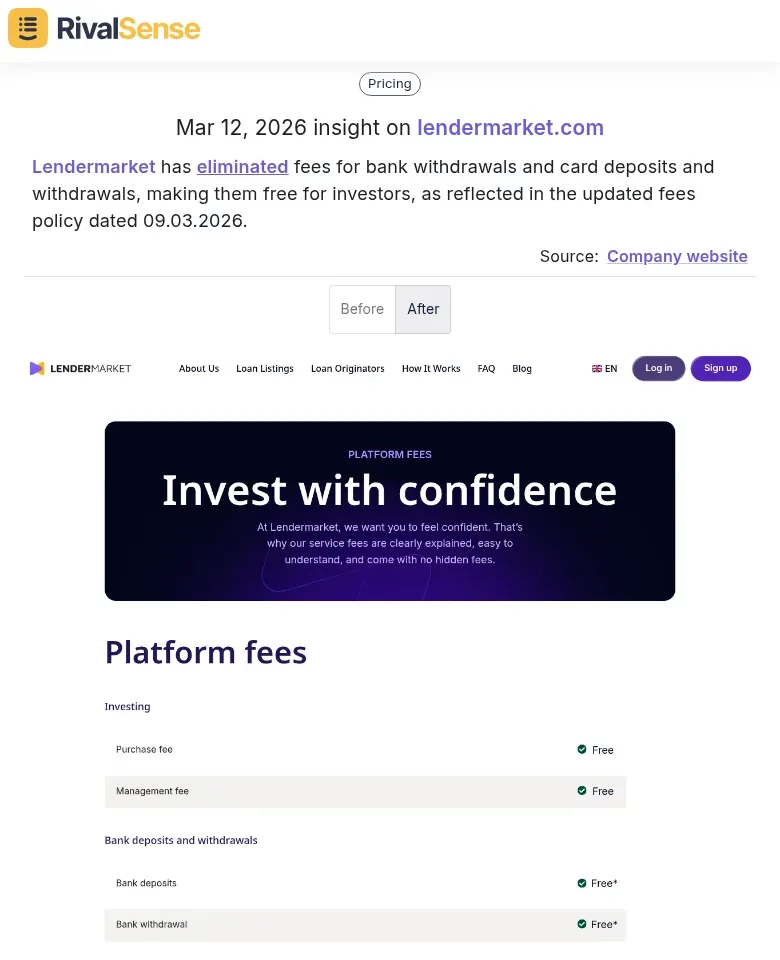
Pricing Updates: Lendermarket has eliminated fees for bank withdrawals and card deposits and withdrawals, making them free for investors, as reflected in the updated fees policy dated 09.03.2026.
Why it matters: Monitoring pricing changes helps you anticipate competitor moves that affect client value perception and market positioning, allowing you to adjust your own pricing strategy proactively. -
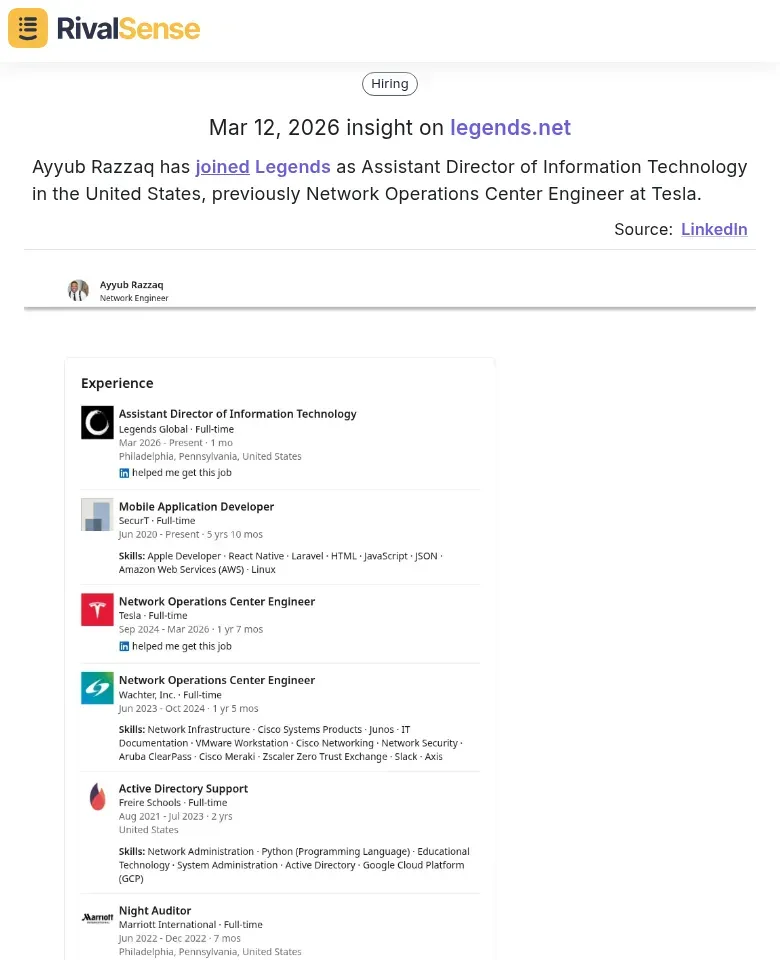
Management Changes: Ayyub Razzaq has joined Legends as Assistant Director of Information Technology in the United States, previously Network Operations Center Engineer at Tesla.
Why it matters: Tracking management hires reveals competitor investment in talent and potential strategic shifts, enabling you to benchmark your talent strategy and identify recruitment opportunities. -
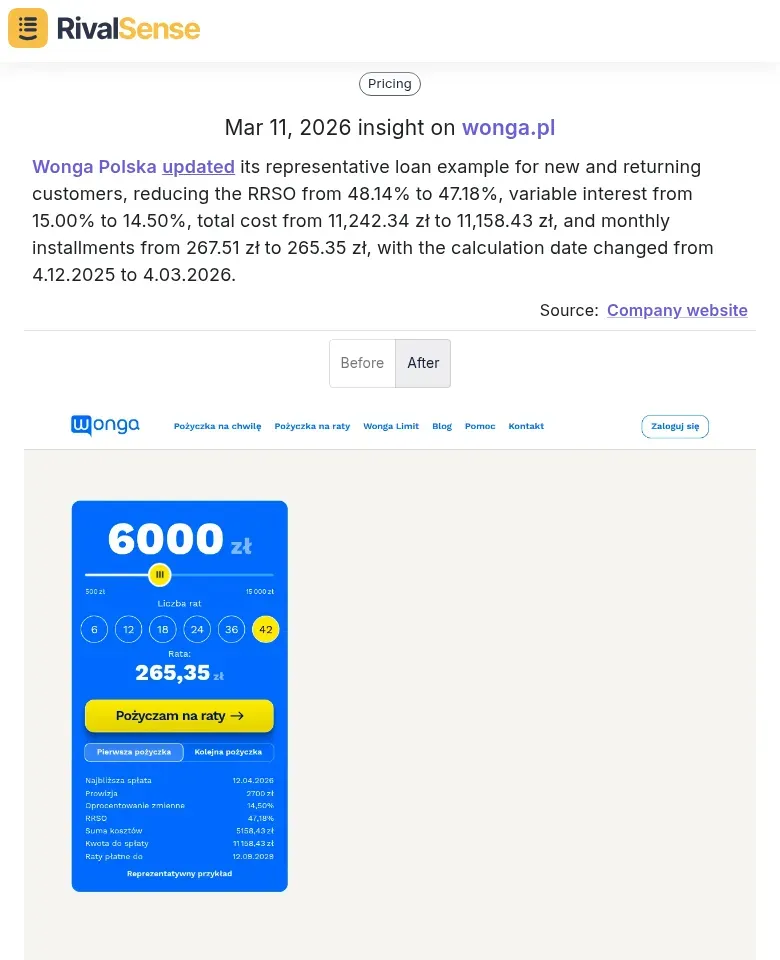
Regulatory and Pricing Adjustments: Wonga Polska updated its representative loan example for new and returning customers, reducing the RRSO from 48.14% to 47.18%, variable interest from 15.00% to 14.50%, total cost from 11,242.34 zł to 11,158.43 zł, and monthly installments from 267.51 zł to 265.35 zł, with the calculation date changed from 4.12.2025 to 4.03.2026.
Why it matters: Regulatory and pricing updates indicate compliance adaptations and competitive positioning, helping you stay aligned with industry standards and client expectations.
For management consulting firms, applying such competitor tracking to sentiment analysis enhances strategic agility, from service development to reputation management.
Future Outlook: Predictive Sentiment Analysis and 2027 Competitive Positioning
Looking ahead to 2027, predictive sentiment analysis will revolutionize how consulting firms anticipate market positioning. Emerging technologies like transformer-based NLP models and multimodal AI will analyze not just text but tone, imagery, and behavioral patterns across platforms, predicting sentiment shifts 6-12 months in advance. As AI implementation matures, expect sentiment to polarize: firms demonstrating ethical AI use and human-AI collaboration will see positive sentiment (+15-20%), while those perceived as replacing human expertise will face backlash (-10-15%).
The "AI empathy gap" will become a critical sentiment driver, making transparency and trust paramount. Strategic recommendations for 2027 positioning include implementing quarterly predictive sentiment audits and developing frameworks to anticipate negative scenarios.
🚀 Strategic Recommendations for 2027:
- Implement quarterly predictive sentiment audits using AI tools that analyze competitor positioning.
- Develop "sentiment resilience frameworks" that anticipate 3-5 potential negative sentiment scenarios.
- Create transparent AI governance documentation to build trust (publicly share AI ethics policies).
- Establish real-time sentiment monitoring dashboards with predictive alerts.
- Train client-facing teams on sentiment-aware communication protocols.
💡 Practical tip: Start building your 2027 sentiment baseline now by tracking how competitors' AI announcements impact their brand perception. The firms that master predictive sentiment will control the 2027 competitive narrative.
Take Action with Competitor Intelligence
To stay ahead in 2026, leverage tools that automate competitor tracking and sentiment analysis. RivalSense monitors competitor product launches, pricing updates, management changes, regulatory aspects, and more, delivering insights in a weekly email report. This helps you decode the strategies behind brand sentiment shifts and respond proactively.
🔍 Try RivalSense for free at https://rivalsense.co/ and get your first competitor report today to apply these insights to your consulting firm's strategy.
📚 Read more
👉 How RivalSense Helped a Competitor Counter Lendermarket's Fee Elimination
👉 Best Practices for Instagram Competitor Loyalty Program Analysis
👉 Mastering Key Account Management in Security Technology: A Strategic Guide
👉 Competitor Partnership Analysis: Strategic Tracking for Key Account Renewals